
Sākums Animals Patagonian mara

Patagonian mara

Taxonomy

Conservation 

IUCN – NT (Near Threatened) – nearly threatened species

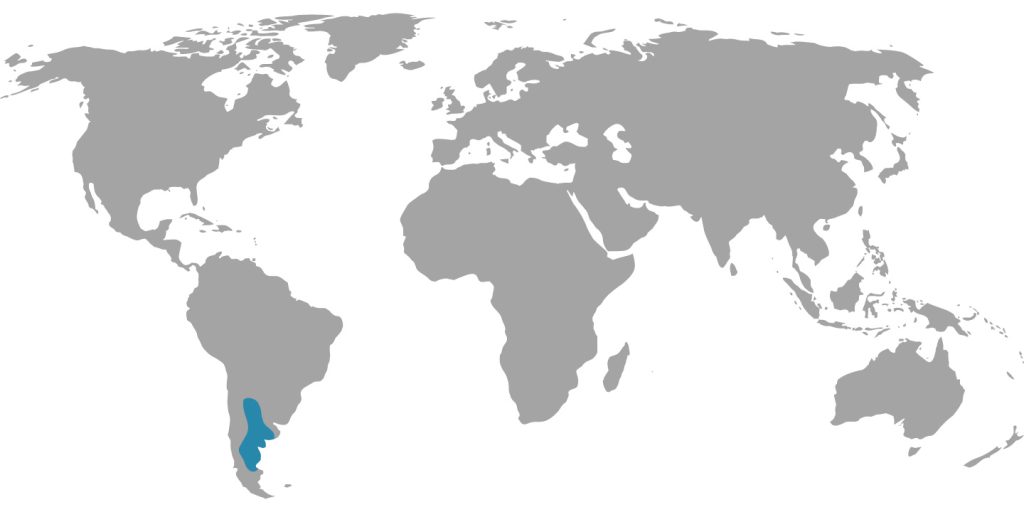
Distribution and Habitat 

Patagonian maras live in Argentina in dry, open grasslands, steppes, and deserts. They dig burrows in habitats with low grass cover.
Adaptations 

Patagonian maras are medium-sized rodents, with a body length of 60 to 80 cm and an average weight of around 8 kg. Males are larger than females. Compared to other members of the cavy family, maras have longer ears and shorter tails, which they keep close to their bodies.

Their body shape is similar to that of a hare, allowing them to run very fast—up to 70 km/h!

Their fur is a mix of reddish, grey, and brown tones, with a white underside.

Diet 

Maras are herbivores that adapt well to the available food in their environment. They mainly eat grasses, especially plants from the Pappophorum, Poa, and Panicum genera. They also feed on various cacti, which are likely an important source of water.

Maras practice a form of re-digestion similar to ruminants. Their food is first fermented by bacteria in the cecum, forming special feces that they eat again to fully digest and absorb the nutrients.

Breeding 

Patagonian maras are monogamous animals that form lifelong pairs. The male closely guards his mate, staying near her at all times and regularly marking her with his scent (using urine and gland secretions). Both males and females reach sexual maturity at around 8 to 9 months of age.

The breeding season lasts from August to December. Maras dig burrows, known as breeding warrens, where females give birth and raise their young. Males do not care for the offspring but protect the territory during this time.

Conservation and Threats 

Patagonian maras are mainly threatened by habitat loss, often due to agricultural development, and hunting for their fur. They are also affected by invasive species, such as European hares, which compete with maras for food.

Their range includes 12 protected areas, and the species is listed on Argentina’s Red List.


References:

Baldi, R. (2007). Breeding success of the endemic mara Dolichotis patagonum in relation to habitat selection: Conservation implications. Journal of Arid Environments, 68(1), 9-19.

Roach, N. . 2016. Dolichotis patagonum. The IUCN Red List of Threatened Species 2016: e.T6785A22190337. https://dx.doi.org/10.2305/IUCN.UK.2016-2.RLTS.T6785A22190337.en.

AnimalDiversityWeb. Patagonian mara. https://animaldiversity.org/accounts/Dolichotis_patagonum/#6BA267E3-4B23-40F4-9946-9AABE758A57C

Subscribe to newsletter

Our supporters and partners

This website uses cookies

Cookies

We use cookies to improve your experience, personalize content and ads, provide social media features, and analyze traffic. We may share this information with our partners, who may combine it with other data you've provided or they've collected.

Name_EN Source_EN Expiration_EN Purpose_EN
_consent_given gpu.lv 7 dienas The cookie ensures the functionality of the cookie module.
_consent_types gpu.lv 7 dienas The cookie ensures the functionality of the cookie module
_consent_yt gpu.lv 7 dienas Cookie ensures the functionality of the cookie module
cookiewp_hide gpu.lv 7 dienas Cookie ensures the functionality of the cookie module
PHPSESSID gpu.lv Sesija Session identifier generated by the PHP server to track the user session on the website
wp-wpml_current_language gpu.lv Sesija Cookie stores the user's language preference
_ga Google Analytics 2 gadi Cookie enables counting of unique visitors and analysis of user behaviour on the website
_fbp Facebook 3 mēneši Cookie allows measuring the effectiveness of marketing activities and helps tailor them to different target groups
_consent_yt Youtube 6 mēneši Cookie collects video viewing data for the YouTube platform

Essential cookies provide key functions such as the website’s core functionality and ease of use. They are crucial for secure service delivery, and the website cannot function properly or fully without them. These cookies identify the user’s device but do not reveal their identity or collect any personal information. Essential cookies are stored on the user’s device until the web browser is closed.
Marketing cookies are used to tailor advertisements and notifications based on the visitor's interests, as well as to measure the effectiveness of marketing activities.
Our website uses statistical cookies that are stored on your device and allow us to analyze how you interact with our site. “Google Analytics” cookies are used to improve the quality of website content and tailor it to users needs.
Other cookies are personalized or third-party cookies that do not fall into any of the standard cookie categories.