
Greater Flamingo
Taxonomy
- Phylum: Chordata – chordates
- Class: Aves – birds
- Order: Phoenicopteriformes – flamingos
- Family: Phoenicopteridae – flamingos
- Species: Phoenicopterus roseus – Greater Flamingo
Conservation


Distribution and Habitat
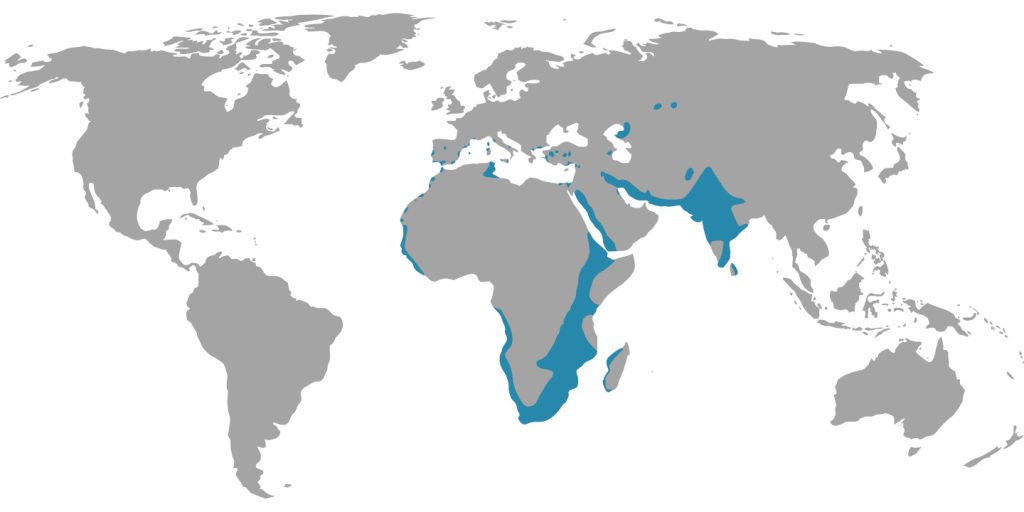
The greater flamingo lives across a wide area – from West Africa to South Africa, the Mediterranean region, as well as in Southwest and South Asia, including India and Sri Lanka. They can also be found in some parts of Europe and Central Asia.
Flamingos inhabit inland wetlands and coastal areas with shallow water (up to 1 m deep). Greater flamingos are observed in bodies of water such as lagoons, salt lakes, and even wastewater treatment ponds.
These birds are partially migratory – they move to areas with suitable water levels and enough food.
Adaptations
Greater flamingos are 1.1–1.5 meters tall and weigh 2–4.5 kilograms. Their wingspan can reach up to 1.9 meters.
Young flamingos can be recognized by their light grey bill with a black tip, while adults have a pink bill with a black tip. Greater flamingos are often seen in large flocks, which can range from 10 to as many as 20,000 pairs.
Diet
The bird’s long neck and legs allow it to feed in deeper water than other wading birds. They use their webbed feet to stir up the bottom of the water, making food rise from the mud. Since they feed with their head upside down, their upper jaw is larger than the lower one. The edges of the bill are specially adapted to filter food from water and mud.
They mainly feed on crustaceans, mollusks, various insect larvae, and small fish. Sometimes they also eat seeds of various plants, algae, and decaying leaves. If flamingos have digestive problems, they eat wet soil to relieve stomach discomfort.
Breeding
Greater flamingos nest in large, dense colonies in reservoirs or wetlands, less often on open, rocky islands. Nests are placed closely together (20–50 cm apart). The nests are made from hardened mud and have a shallow depression for the egg and an elevation to protect from flooding.
Greater flamingos are seasonally monogamous – they form a pair for one season, which may change in the next season or if the first nesting attempt is unsuccessful.
They lay only one egg, but if it fails to hatch, the egg is abandoned, and a new nesting attempt begins. Both the male and female incubate the egg in turns for 27–36 days. Flamingo chicks leave the nest after a week but are not entirely alone – they form groups
with other young flamingos. They take their first flight at the age of 71–98 days. They leave the colony completely after 80–139 days.
Conservation and threats
Greater flamingos and their eggs suffer from poaching, as these beautiful birds are in high demand among private collectors. Therefore, the species is included in the CITES (Washington Convention) to regulate the trade of feathers, eggs, taxidermy, and live flamingos.
The species is also threatened by environmental degradation. Due to climate change, wetlands that are vital to flamingos are drying up. Regional conservation organizations have established several protected areas for flamingos and other migratory birds, which also protect all other animals and plants living there.


Our supporters and partners


