
Common Crane
Taxonomy
- Phylum: Chordata – chordates
- Class: Aves – birds
- Order: Gruiformes – cranes and allies
- Family: Gruidae – cranes
- Species: Grus grus – Common crane
- Subspecies: Grus grus grus – Common crane
Conservation


Distribution and habitat
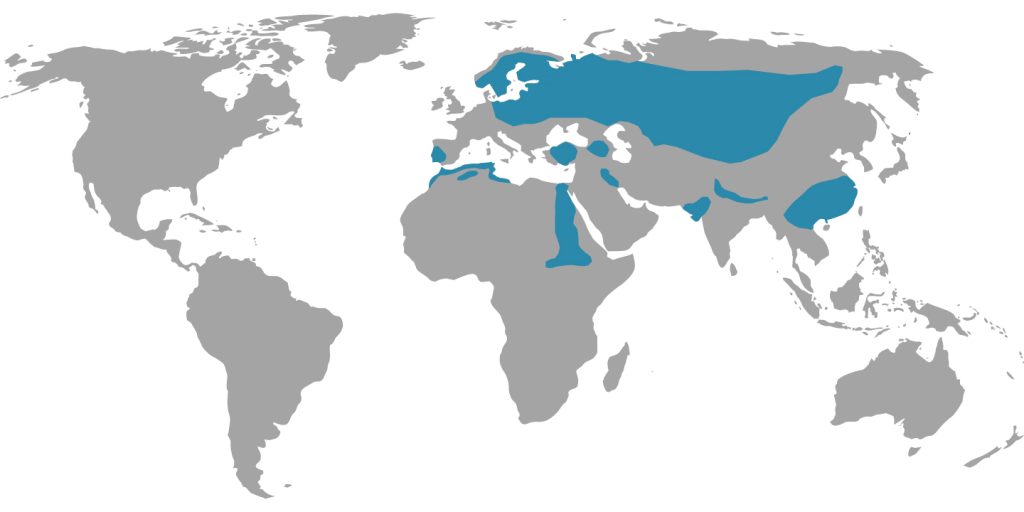
A wide distribution range across Eurasia. It is the only crane species found in Latvia – present throughout the country in summer, while in winter only a few individuals remain. Globally, it inhabits various shallow wetlands and grasslands, while in Latvia it is found in different moss and sedge bogs and wet forests.
Adaptions
Common cranes are 1 to 1.3 metres tall, and their wingspan is 1.8 to 2.4 metres. They weigh from 4.5 to 6.1 kilograms. Crane males and females are difficult to tell apart, but males are slightly larger.
Cranes are very vocal and have a very distinct call that can be heard kilometres away.
When in flight, cranes can be distinguished from herons by their neck – cranes fly with a straight neck, but herons have a bent neck.
Diet
Cranes are omnivores that mainly feed during the day. They feed on various sprouts, leaves, berries and grain. They also hunt invertebrates, frogs, lizards, fish and small mammals. Cranes find food by stomping in shallow water or on land.
Breeding
Cranes mainly stay in flocks, but during the breeding season they form pairs. During courtship, cranes often perform characteristic “wedding dances,” leaping into the air with outstretched wings. Cranes are mostly monogamous, but for various reasons—such as the death of a previous partner or unsuccessful breeding —they may change partners.
In Latvia, nesting takes place in April and May. The nest is relatively simple but built high enough so that the eggs are not in the water. It is made from various dry plants. The clutch usually contains two grayish-brown, speckled eggs, rarely one or even four. Incubation lasts from 28 to 31 days and is mostly done by the female.
The chicks are precocial. Although they are quite helpless immediately after hatching, within 24 hours they can already run and swim. The chicks’ plumage is soft and reddish-brown. They are able to fly at about nine weeks of age. While the adult birds care for the young, the chicks undergo molting and grow new feathers.
Conservation and threats
Common cranes are included in Bonn Convention on migratory species, Birds Directive and Bern Convention. Thanks to many conservation efforts all over their distribution area common crane population is increasing.


Our supporters and partners


