
Vicuña

Taxonomy

Conservation

IUCN – LC (Least Concern)
CITES – Yes
EAZA (EEP) – Yes

Distribution and habitat

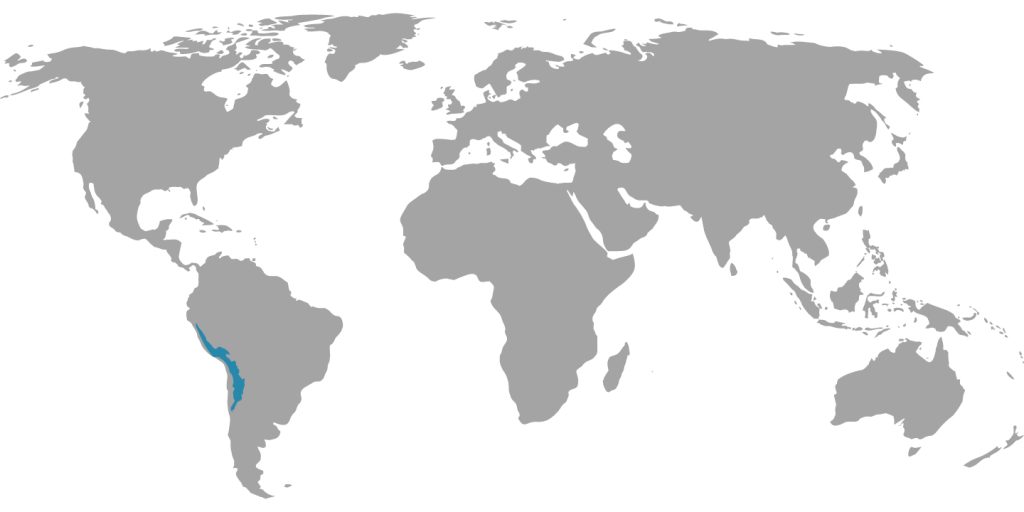
Vicuna is found in South America, specifically Puna and the High Andean ecosystems, however over half of the total world’s population of vicuna live in Perú. Vicuna is a high-altitude ungulate.  

Vicunas’ daily activity patterns and movements are also strongly influenced by water availability, especially during the summer. In the night and early morning vicunas move to hillsides to avoid predation from pumas and foxes. 
Adaptions

The vicuna is the smallest of the South American camelids. Their height ranges from 1.45 to 1.60 m, the shoulder height from 75 to 85 cm and the weight from 35 to 65 kg. 

Vicunas are specially adapted to their high-altitude habitats. Their thick, soft fur traps layers of warm air close to their bodies, protecting them from low temperatures. Vicunas walk on the soles of their feet, so that they can flex their toes and cling to gravel-covered rocks and slopes.  

Living in open areas, the long neck allows it to detect the presence of predators from a distance. 

Diet 

The vicuna is a generalist herbivore that behaves as a facultative grazer that can also include shrubs in its diet. 

The vicuna’s lower teeth are constantly growing so that they can eat tough grasses. They also chew their cud when resting to extract more nutrients from the grass. 

Breeding 

Vicunas are polygamous – they do not make stable pairs for breeding and care for the babies. Typically, vicunas make a group consisting of one male, two to fifteen females, and their offspring. Females are attracted to a feeding area monopolized by a territorial male. Females remain primarily within the territory, although in some populations there is movement between different social units, resulting in variable social organization.  

Pregnancy lasts about 11 months. Vicunas are born in late summer, when there is the most amount of food in steppe. Females breed again about two weeks later.  

Vicunas feed their young with milk for around 8 months. Milk is very rich in nutrients, so the cubs grow quickly. Offspring are forcibly dispersed from their family group by the male before the next breeding season. Females move to new groups and males that cannot guard their own territory yet create bachelor groups.

Conservation and threats

Poaching triggered by international illegal market demands of vicuna fibre continues to be the major threat to the species. 

Other significant threats are urbanization of their habitat, intensive tourism and agriculture. 


References: 

Arzamendia, Y., Carbajo, A. E., & Vilá, B. (2018). Social group dynamics and composition of managed wild vicuñas (Vicugna vicugna vicugna) in Jujuy, Argentina. Journal of Ethology36(2), 125-134. 

Bonacic, C., Macdonald, D. W., Galaz, J., & Sibly, R. M. (2002). Density dependence in the camelid Vicugna vicugna: the recovery of a protected population in Chile. Oryx36(2), 118-125. 

Borgnia, M., Vilá, B. L., & Cassini, M. H. (2008). Interaction between wild camelids and livestock in an Andean semi-desert. Journal of Arid Environments72(12), 2150-2158. 

Franklin, W.L. 2011. Family Camelidae (camels). In: Wilson, D.E. and Mittermeier, R.A. (eds), Handbook of the mammals of the world. Vol. 2. Hoofed mammals, pp. 206–246. Lynx editions, Barcelona. 

Mata, C., Malo, J. E., Galaz, J. L., Cadorzo, C., & Lagunas, H. (2016). A three-step approach to minimise the impact of a mining site on vicuña (Vicugna vicugna) and to restore landscape connectivity. Environmental Science and Pollution Research23, 13626-13636. 

South American Camelid Specialist Group – IUCN. 2014. Poaching of Vicuña and the Illegal Commercialization of its Fiber: A Persisting Problem. IUCN. 

Wheeler, J. C. (2012). South American camelids-past, present and future. 

IUCN https://www.iucnredlist.org/species/22956/145360542 

Subscribe to newsletter

Our supporters and partners

This website uses cookies

Cookies

We use cookies to improve your experience, personalize content and ads, provide social media features, and analyze traffic. We may share this information with our partners, who may combine it with other data you've provided or they've collected.

Name_EN Source_EN Expiration_EN Purpose_EN
_consent_given gpu.lv 7 dienas The cookie ensures the functionality of the cookie module.
_consent_types gpu.lv 7 dienas The cookie ensures the functionality of the cookie module
_consent_yt gpu.lv 7 dienas Cookie ensures the functionality of the cookie module
cookiewp_hide gpu.lv 7 dienas Cookie ensures the functionality of the cookie module
PHPSESSID gpu.lv Sesija Session identifier generated by the PHP server to track the user session on the website
wp-wpml_current_language gpu.lv Sesija Cookie stores the user's language preference
_ga Google Analytics 2 gadi Cookie enables counting of unique visitors and analysis of user behaviour on the website
_fbp Facebook 3 mēneši Cookie allows measuring the effectiveness of marketing activities and helps tailor them to different target groups
_consent_yt Youtube 6 mēneši Cookie collects video viewing data for the YouTube platform

Essential cookies provide key functions such as the website’s core functionality and ease of use. They are crucial for secure service delivery, and the website cannot function properly or fully without them. These cookies identify the user’s device but do not reveal their identity or collect any personal information. Essential cookies are stored on the user’s device until the web browser is closed.
Marketing cookies are used to tailor advertisements and notifications based on the visitor's interests, as well as to measure the effectiveness of marketing activities.
Our website uses statistical cookies that are stored on your device and allow us to analyze how you interact with our site. “Google Analytics” cookies are used to improve the quality of website content and tailor it to users needs.
Other cookies are personalized or third-party cookies that do not fall into any of the standard cookie categories.