
Three-banded Armadillo
Taxonomy
- Phylum: Chordata – chordate
- Class: Mammalia – mammal
- Order: Cingulata – armadillos
- Family: Chlamyphoridae – Short-nosed armadillos
- Species: Tolypeutes matacus – Southern three-banded armadillo
Conservation

Distribution and habitat
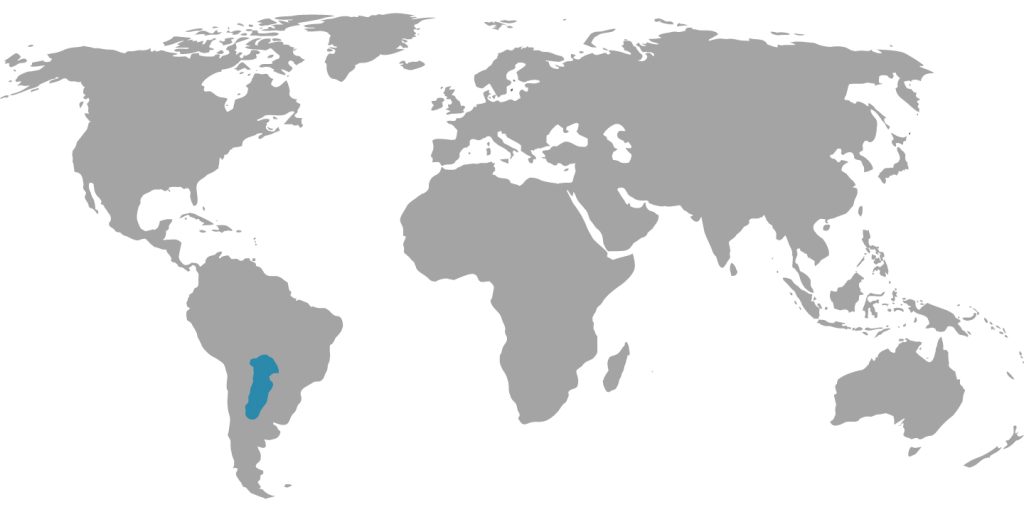
Southern three-banded armadillo inhabits South America, north and central Argentina, east and central Bolivia and some locations in Brazil and Paraguay. Most often they are found in grasslands or swampy habitats between forests.
Adaptions
Southern three-banded armadillo are 20 to 30 cm long and have a 6 to 8 cm long tail. On average armadillos weigh from 1 to 2 kilograms.
Outer part of armadillo’s armour is a transformed, hard skin. It is made of keratin – the same thing that makes nails and hair. Southern three-banded armadillos are the only species of armadillos that can fully curl into a ball. When curled up, armadillos can leave a small gap where an attacker can put in nose or fingers. Then armadillo snaps the plate closed, injuring the attacker.
Diet
Armadillos are insectivores. They mainly feed on bugs – beetle larvae, ants and termites. Armadillos have a great sense of smell and large, powerful claws that help them to find food in soil and rotting wood.
To catch and eat bugs armadillos have a long tongue and sharp teeth.
Breeding
Armadillos only meet during the breeding season.
Pregnancy lasts for about 120 days. Armadillos are mostly born from November to January. Only one, golf ball sized pup is born, but it is very active as soon as it is born – it already has armour, and it can roll into a ball.
Only the mother takes care of the pup, feeding it with milk for about 2 months. At that age the pup is already fully independent. Armadillo is fully grown around 9 to 12 months.
Conservation and threats
Rolling into a ball is not an effective method to protect yourself from human activity – Southern three-banded armadillos are threatened by illegal hunting and habitat loss. Large areas of South America are being transformed into agricultural land.


Our supporters and partners


