
Snowy Owl
Taxonomy
- Phylum: Chordata – chordates
- Class: Aves – birds
- Order: Strigiformes – owls
- Family: Strigidae – typical owls
- Species: Bubo scandiacus – Snowy Owl
Conservation


Distribution and habitat
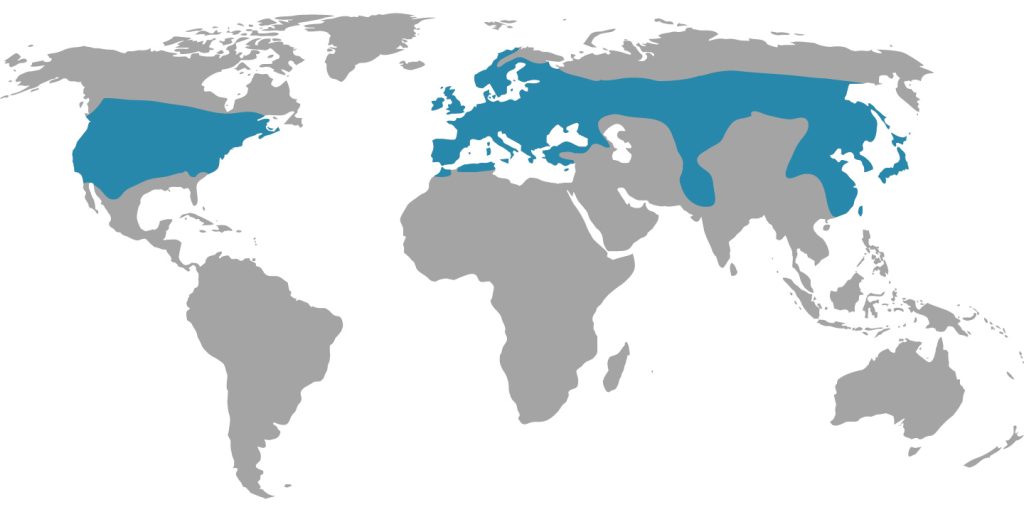
The snowy owl is found in the Northern Hemisphere — in Eurasia, North America, and Greenland. The owls live in tundra habitats, nesting closer to the coasts during the breeding season. In Latvia, they are very rare visitors.
Adaptions
A large owl species, with females generally larger than males. The body length of males ranges from 55–64 cm, while females measure 60–70 cm. Males weigh between 700 and 2500 g, and females between 780 and 2950 g. The wingspan varies from 150 to 170 cm.
Males and females differ in plumage coloration. Males are almost entirely white, while females are white with black spots. The mottled pattern helps camouflage the female in the tundra during the nesting season, when most of the snow has melted. The snowy owl’s plumage provides excellent insulation — thick feathers cover the bird from its toes to its beak. They spend much of their time sitting on the ground and observing their surroundings. Snowy owls are territorial and spend most of their lives alone.
Diet
Snowy owls hunt small mammals, especially lemmings and voles. When their usual prey is less common, the owls may also hunt birds. They search for prey while perched on a lookout (for example, a low tree), and once they spot it, they capture it in a low flight. Their sharp eyesight and hearing allow them to locate lemmings beneath the snow.
Breeding
Snowy owls form monogamous pairs, although it has been observed that in seasons with abundant food, a male may mate with several females. The male courts the female with a display that includes dancing both in the air and on the ground. Breeding takes place from May to September. The female digs a small, simple hollow in the ground without any nesting material. She lays 3 to 11 eggs and incubates them for about a month. After hatching, both parents care for the chicks for another 2–3 weeks until they become independent and leave the nest.
Breeding success depends on the number of lemmings available in a given season, which periodically (every 3–4 years) increases and decreases. The more food there is, the more chicks snowy owls raise.
Conservation and threats
Snowy owls occupy vast territories, but their numbers are low, and populations are declining. Climate change poses a major threat, as it affects the abundance of lemmings, which in turn negatively impacts the breeding success of snowy owls.
In 2021, Rīga ZOO began studying the fluorescence abilities of European owls. In collaboration with the University of Latvia’s Faculty of Biology, the Institute of Solid State Physics, and the University of L’Aquila (Italy), the research team discovered for the first time that the snowy owl (Bubo scandiacus) also exhibits fluorescence—disproving the previous belief that this species lacked that trait. See publications.


Our supporters and partners


