
Siberian Flying Squirrel
Taxonomy
- Phylum: Chordata – chordates
- Class: Mammalia – mammals
- Order: Rodentia – rodents
- Family: Sciuridae – squirrels
- Species: Pteromys volans – Siberian Flying Squirrel
Conservation

Distribution and Habitat
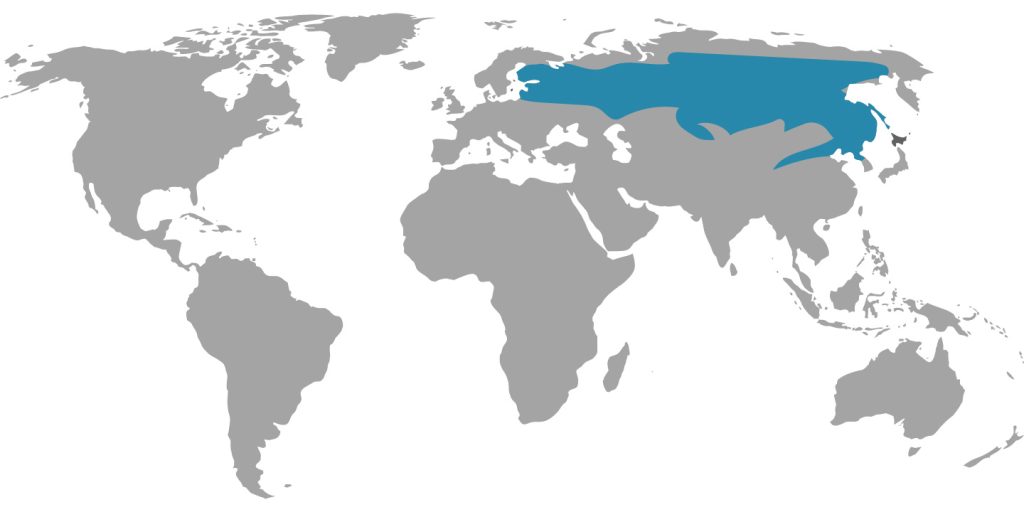
The Siberian flying squirrel has a wide distribution across the northern regions of Eurasia. It inhabits various types of boreal forests, particularly favoring old mixed stands of spruce and aspen. Ideal habitats include forests where second-layer spruces have developed beneath the canopy. Aspens provide suitable tree cavities for nesting, while the dense foliage of spruces offers essential cover from predators such as owls and martens.
Adaptations
Siberian flying squirrels are 12 to 23 centimeters long, not including their tail, which is nearly as long as their body. Males and females look very similar, though females tend to be slightly larger – averaging around 150 grams, while males weigh about 140 grams.
Their gray fur provides excellent camouflage when climbing tree trunks. In summer, the coat becomes thinner and slightly yellowish, while in winter it thickens to help retain body heat. The belly fur is always white, regardless of the season.
Despite their name, flying squirrels do not actually fly. Instead, a special membrane of skin stretching between their front and hind legs allows them to glide skillfully from tree to tree.
Flying squirrels are most active at dusk and during the night. Their large eyes are specially adapted to help them see in the dark.
Diet
The diet of the Siberian flying squirrel varies with the seasons. They primarily feed on the leaves, catkins (flower clusters) of trees and shrubs—such as birch and alder—as well as buds and a variety of seeds. Although they spend most of their time in trees, flying squirrels occasionally descend to the ground to forage.
Breeding
Reproduction in Siberian flying squirrels is not well studied in the wild. They usually give birth once a year, though in some cases a second litter may occur. The first litter is typically born in May, and the second in late June or early July. Each litter may include anywhere from one to six young. The gestation period lasts approximately four weeks.
Conservation and threats
Although the species is listed as Least Concern in the IUCN Red List globally, it is considered Near Threatened in Europe. In Latvia, the Siberian flying squirrel population is likely extinct, despite the occasional possibility of individuals migrating from Estonia or Russia.
The main cause of population decline is forest fragmentation due to logging, which breaks up old-growth forests and isolates flying squirrels into small, non-viable groups.
Rīga ZOO is home to the largest group of Siberian flying squirrels in Europe. Here, they are kept outdoors in conditions that closely resemble their natural habitat. The best time to spot them is during winter, shortly before the zoo closes for the day.


Our supporters and partners


